
Welcome Center
Check in with identification, confirm the day’s talks and programs, and note any path or room changes before walking downhill.
Grace Farms guide
Grace Farms is free to enter with advance registration. Tokyo architecture studio SANAA designed the low silver roof that links public spaces across an 80-acre landscape of paths, pond, restored meadow, art, and changing programs.
Allow a half-day for the River building and grounds. The structure descends with the land in a chain of glass pavilions beneath one flowing roof, moving from the Welcome Center to the library, Commons, Pavilion, and Court. Curved glass keeps the meadow, trees, weather, and other visitors visible from room to room.
Check in with identification, confirm the day’s talks and programs, and note any path or room changes before walking downhill.
Follow the curving roof from the library and Commons toward the Pavilion and Court. Glass walls keep the meadow and trees visible while room scale and use change along the slope.
The Commons provides tables and light fare during current service. Tea Pavilion hours are narrower and should be checked separately.
The one-mile landscape loop crosses ten habitats and frames restored meadow, wetland, woodland, and pond edges beyond the celebrated roofline.
The River is not one large hall. The library supports reading and small gatherings; the Commons provides food and tables; the Pavilion hosts talks and performances; and the subterranean Court accommodates recreation. These uses occupy separate glass volumes linked by the roof, so a public event can change which rooms are active without changing the basic route through the building.
Register directly with Grace Farms, bring identification for the arrival kiosk, and follow staff guidance. Visits, events, programs, and tours should be reserved through Grace Farms rather than a third party.
On a day without a tour or performance, concentrate on the River’s architecture, the Commons, current art, and the Cattail Pond loop. A public tour adds formal interpretation of the building and landscape. A talk, family program, or performance can become the fixed point of the visit, with the meadow and public rooms before or afterward.
Food also follows its own schedule. The Commons is the more dependable place to look for light fare during public hours; Tea Pavilion service is narrower. Check both directly rather than assuming every room named on a site map will be open or serving throughout the day. Sunday’s noon opening makes breakfast in New Canaan the practical start before the drive to Grace Farms.
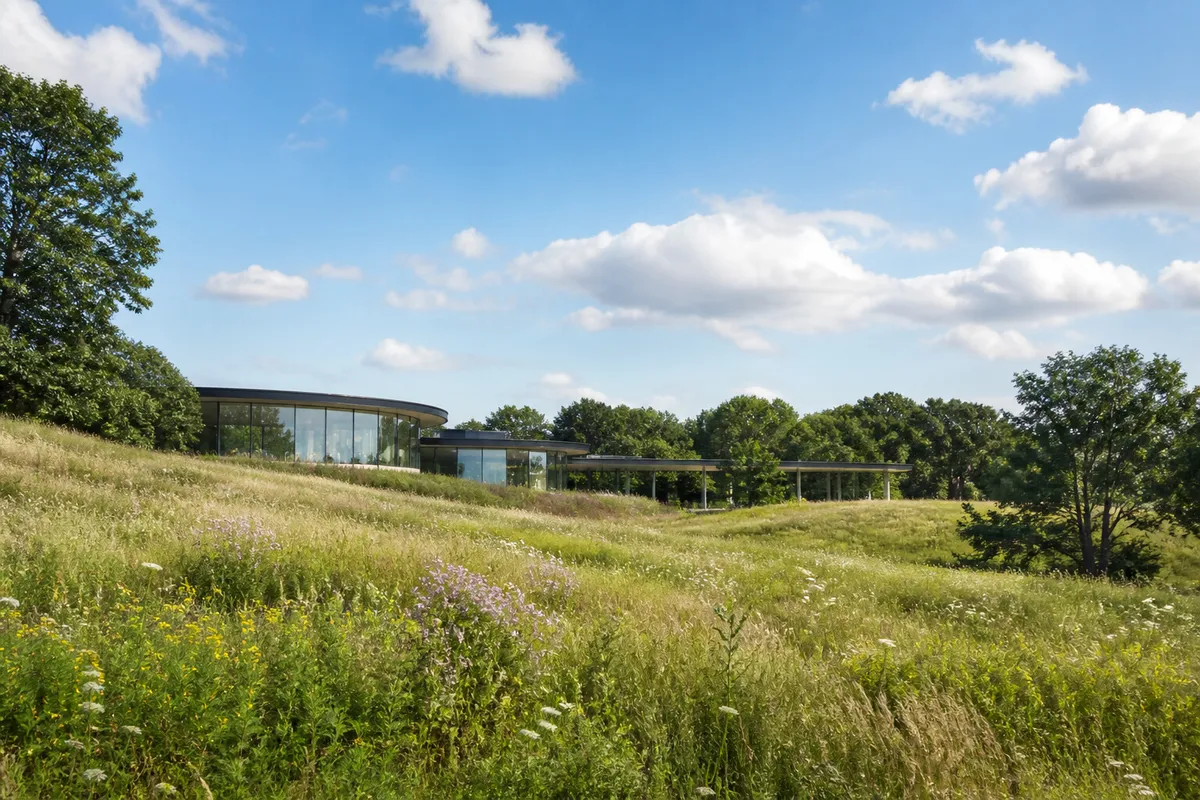
The Cattail Pond loop is the simplest way to move beyond the roofline. Its mile-long circuit encounters ten habitats and restored native meadows. Wear shoes that can handle damp mown paths, especially after rain, and allow enough daylight to return before a reserved program.
Art appears throughout the buildings and grounds rather than inside one conventional gallery. Current installations and exhibits may change, so check the official artworks and events pages before arriving. Pop-up talks can add useful context without consuming the whole day.
In dry weather, walk the full pond loop after seeing the River so the building can be viewed across meadow, wetland, and woodland edges. The mown paths can be damp after rain. If conditions shorten the outdoor portion, spend more time in the library, Commons, Pavilion, Court, and current art spaces that are open to visitors.
The continuous roof makes the River legible from several points along the slope, not only from the arrival path. Compare the roof’s height over each volume, the changing curve of the glass walls, and views back toward rooms already crossed. Visitors who want a landscape walk need shoes for the grounds; visitors focused on architecture can still have a substantial visit when the full loop is impractical.
The arrival elevation gives the clearest view of the River’s overall descent. From there, the roof drops with the hillside and widens or narrows over individual pavilions. Inside, the route moves between quieter rooms, food and conversation in the Commons, larger gathering space in the Pavilion, and the Court below grade. The rooms do not have identical proportions or uses even though one roof connects them.
Curved glass produces changing reflections as visitors move downhill. At some points the meadow is visible through more than one volume; at others, columns, roof edges, people, and reflected trees overlap. Walk outside alongside part of the building as well as through it. The exterior path shows how lightly the pavilions meet the slope and how the Court’s larger volume is absorbed into the ground.
Current art can alter that spatial sequence. An installation in a public room or on the grounds may redirect attention to a particular view, material, or path, while an event may limit ordinary access to a pavilion. The artworks and events pages are therefore useful before arrival, not merely background reading after the visit.
Grace Farms currently lists free public visiting Tuesday through Saturday from 10 a.m. to 5 p.m. and Sunday from noon to 5 p.m., with Monday closed. Public tours are offered on selected Thursdays and Saturdays, and dining or Tea Pavilion hours follow their own schedules. Treat those times as current guidance, not a permanent promise.
All ages are welcome, and the subterranean Court broadens the visit beyond architecture. Families can mix open space, art, nature, and movement rather than requiring children to admire every detail of the roof. Check the calendar for special programs and court availability.
Elm Street supplies restaurants and a compact walk before or after the drive. Waveny Park adds more meadow and an estate landscape without another timed admission. The Glass House belongs on a separate half-day, preferably the other morning, because its ticketed shuttle and tour can take two hours or more before time on Elm Street.
Official resources
Registration, hours, tours, dining, exhibits, and programs change with the calendar.