
One-hour tour
The concise choice reaches the Glass House and Brick House with the least walking. Pick it for the core buildings or when you want time for a second attraction; ask the site which tour fits any accessibility needs.
Glass House guide
Philip Johnson’s 1949 Glass House is the famous rectangle. The 49-acre property extends to the Brick House, galleries, Da Monsta, studio, sculpture, ponds, slopes, and deliberate views.
The Glass House is not a roadside house museum. Every public visit begins at the Visitor Center and Design Store at 199 Elm Street in downtown New Canaan, then continues by shuttle to the property. That puts the station, municipal parking, shops, and restaurants near the check-in point for time before or after the tour.
The concise choice reaches the Glass House and Brick House with the least walking. Pick it for the core buildings or when you want time for a second attraction; ask the site which tour fits any accessibility needs.
The strongest first visit for most architecture travelers adds the Painting Gallery, Sculpture Gallery, and Da Monsta over a two-hour route and roughly three-quarters of a mile.
The Studio joins the core buildings over about two and a half hours and a mile of paths and grass. The additional time reveals more of Johnson’s working environment and the estate’s development beyond the residence and galleries.
April-through-October Sundays allow a slower sequence across more of the campus, but hills and standing demands remain. Confirm the current access notes before booking.
The one-hour route establishes the central opposition between the Glass House and Brick House: transparent and opaque, open living room and enclosed private rooms. It is enough to understand the famous pair, but it leaves less time for the galleries, studio, sculpture, and the estate’s longer sequence of paths and views.
The two-hour galleries tour changes the visit from a house tour into an account of how Johnson displayed art. The Painting Gallery disappears into an earth-covered mound, while the Sculpture Gallery uses white brick, glass roof planes, and angled walls to shape changing daylight. Da Monsta adds a late, sharply distorted building that does not resemble the disciplined grid of the 1949 residence.
The extended and self-guided choices devote more time to the property as a whole. They suit visitors who want the Studio, a longer walk, and more opportunity to compare architecture with lawn, woodland, ponds, stone walls, and sculpture. Confirm the exact inclusions before buying: longer does not simply mean a slower version of the same route.
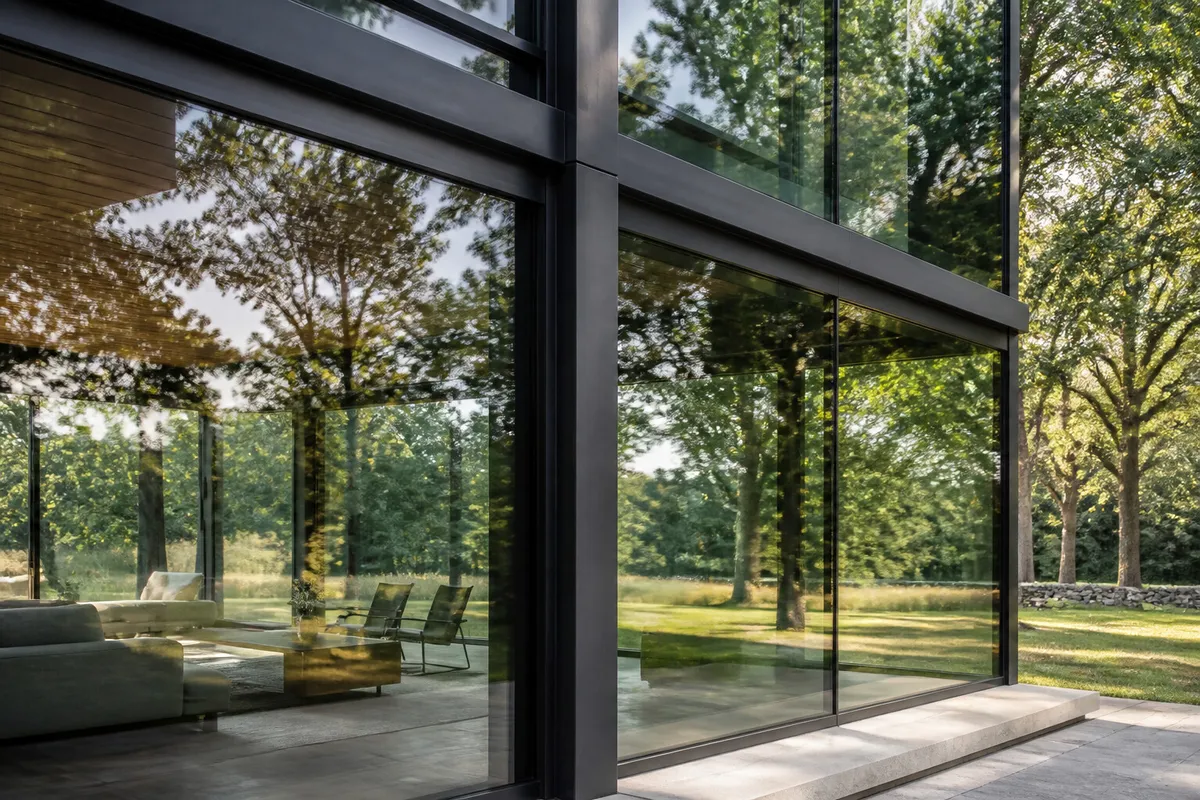
The glass pavilion makes the landscape feel continuous, but the site becomes more interesting when Johnson’s contradictions appear. The opaque Brick House sits opposite the transparent residence. The Painting Gallery is sunk into a grassy mound. The Sculpture Gallery uses angled glass and white brick to turn daylight into part of the collection. Da Monsta abandons the Glass House’s calm geometry for a warped red form.
Views along the paths explain relationships that photographs of one building miss. Lawn, stone walls, trees, and water alternately expose and conceal the architecture. The estate was developed between 1949 and 1995; it records a long experiment rather than a single preserved moment.
The Glass House and Brick House face one another across the lawn, but their materials establish different kinds of privacy. Glass exposes the residence to the landscape; brick encloses bedrooms and mechanical spaces. Farther into the property, the buried Painting Gallery and daylit Sculpture Gallery answer two different problems of displaying art. The Studio separates concentrated work from the social life of the main house.
Movement between those buildings is part of the interpretation. Some structures sit openly in long views; others appear after a turn, behind planting, or within a change in grade. Johnson continued adding to the estate from 1949 through 1995, so the route records decades of revision rather than one fixed mid-century composition. A tour that includes more buildings makes those shifts easier to see.
Art and architecture repeatedly trade places along the route. The galleries are buildings designed around collections, while sculpture also occupies the landscape outside them. The Painting Gallery’s earth cover makes it read as terrain from some approaches. The Sculpture Gallery remains visibly architectural even when attention turns to the work inside. Da Monsta is both an object in the landscape and an inhabitable room. These changes explain why a galleries or extended ticket offers more than additional square footage.
The return toward the Glass House also changes the original view. Its transparent walls can appear less like an isolated icon after the opaque, buried, angular, and red structures elsewhere on the estate. The longer route makes Johnson’s revisions and contradictions visible; the shortest route concentrates on the founding pair.
No general visitor parking is available at the Visitor Center. The Glass House directs visitors to municipal parking and recommends the Lumberyard Lot at 244 Elm Street after 10:30 a.m.; special parking instructions apply to early weekday tours. Read the current visit page before parking, and arrive 15 to 20 minutes before the shuttle time printed on the ticket.
The tour options carry different physical demands. Paths may include gravel, pavement, grass, steps, moderate hills, and prolonged standing. Some self-guided and extended experiences cannot accommodate wheelchairs or scooters. Contact the site in advance for current accessibility arrangements rather than assuming the shortest tour solves every need. Children must be at least eight because the shuttle cannot accommodate car seats.
After a morning tour, stay downtown for lunch and walk Elm Street before moving to Waveny Park or the New Canaan Museum & Historical Society. The museum’s Modern New Canaan work broadens the story beyond Johnson to Marcel Breuer, Landis Gores, John Johansen, Eliot Noyes, and the wider postwar building culture.
Give Grace Farms a separate half-day. The River building by Tokyo architecture studio SANAA uses a low, curving roof to follow the land and connect public spaces. It contrasts with the private glass pavilion and composed estate at the Glass House: two generations and two different relationships between architecture and landscape.
Official resources
Tour availability, prices, buildings, walking demands, and seasonal dates can change.